


👋 Hi, it’s Gaurav and Kunal, and welcome to the Insider Growth Group newsletter—our bi-weekly deep dive into the hidden playbooks behind tech’s fastest-growing companies.
We give you an edge on what’s happening today: actionable strategies, proven frameworks, and access to how top operators are scaling companies across industries. This newsletter helps you boost your key metrics—whether you’re launching a product from scratch or scaling an existing one.
What We Stand For
Actionable Insights: Our content is a no-fluff, practical blueprint you can implement today, featuring real-world examples of what works—and what doesn’t.
Vetted Expertise: We rely on insights from seasoned professionals who truly understand what it takes to scale a business.
Community Learning: Join our network of builders, sharers, and doers to exchange experiences, compare growth tactics, and level up together.
The Pendulum Swings Back
For the last decade, the tech industry optimized for one thing above all else: scale.
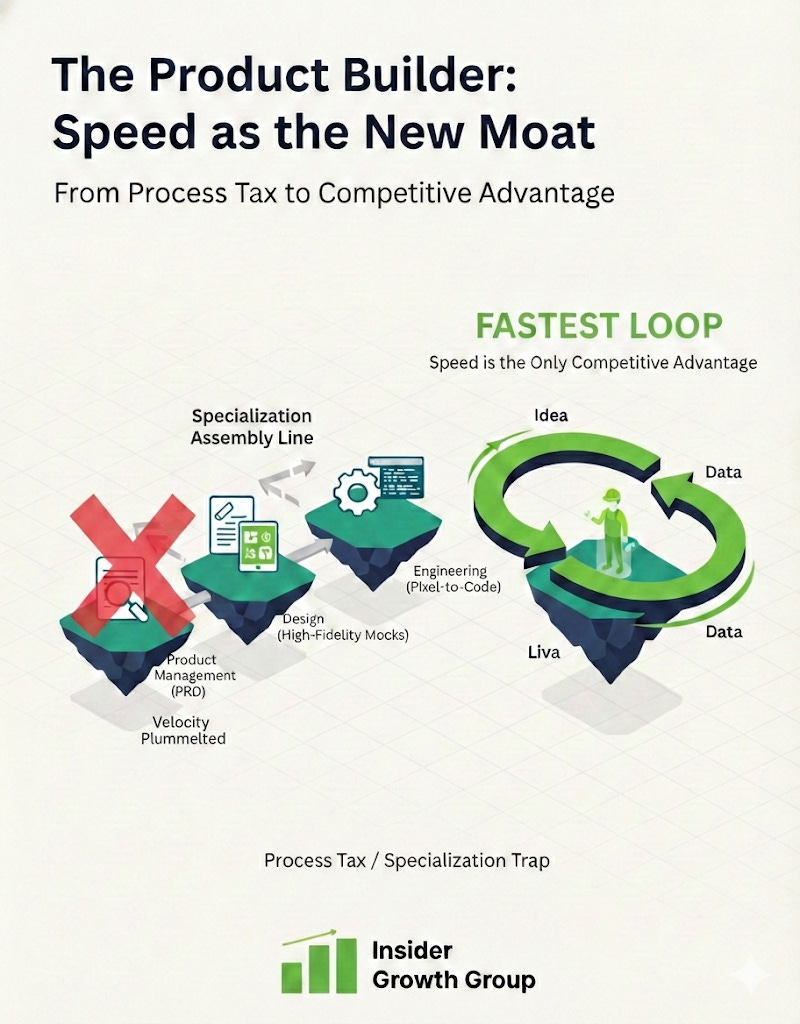
In the pursuit of predictable, repeatable growth, we dismantled the creative heart of the “Product Trio.” We took Product Management, Design, and Engineering and split them so far apart that they became distinct islands with their own languages, their own incentives, and their own bureaucracies. We built “Assembly Lines.” In this model, the PM wrote a 20-page PRD, the Designer spent three weeks in Figma creating high-fidelity mocks, and the Engineer finally received a ticket to turn those pixels into code.
Velocity plummeted.
For years, we were told this was the price of success. We were taught to accept this as the inevitable process tax required to maintain massive cash cows and satisfy the demands of middle management. We convinced ourselves that “moving slow and aligning” was the only way to protect the core business.
But in what we now recognize as the specialization trap of the zero interest / cheap funding era, we traded competitive speed for administrative safety. When capital was free, you could afford to have five people doing the work of one. Today, capital has a cost, and in a constrained market, Speed is the only competitive advantage. The companies winning today aren’t the ones with the most robust “agile ceremonies” or the most beautiful internal documentation. They are the ones with the fastest loop from Idea → Live → Data.
We are entering a new era. The industry is moving away from the role of the pure coordinator—the person whose day is defined by aligning stakeholders, writing status updates, and moving cards on a board. The pendulum is swinging back toward the high-agency operator.
I need to be crystal clear: the bar has fundamentally been raised.
This doesn’t mean you need to hire a full-time builder or convert all your PMs to coders tomorrow. But you must accept that the status quo is gone.
To be fair, we have always advocated for lean validation. Frameworks like Litmus proved years ago that you don’t need a village of five specialists just to test an idea. We have long had the ability to gauge interest and willingness to pay using high-fidelity Figma prototypes or painted-door tests.
But idea validation is no longer enough. The definition of “validation” has shifted from the mockup to the implementation.
Previously, there was a massive chasm between getting a customer to say “I would buy this” (idea validation) and actually handing them a functional feature to see if they use it (implementation validation). Crossing that chasm required scarce engineering resources, which bottlenecked the entire process.
Now, the near-zero cost of building means there is no excuse for stopping at a prototype. You can build the actual, functional application and sell it directly to clients to get candid, behavioral feedback on the whole solution. It just requires one person with generalist skills who is dangerous enough to execute end-to-end.
We call this archetype the Product Builder. This post unpacks why this shift is happening, how it interacts (and clashes) with traditional structures, and how you can harness it to drive revenue.
The Collaboration: Two Perspectives on Velocity
To understand this transformation, we have combined two perspectives that span the spectrum of modern product leadership.
Justin Bauer (Ex-CPO at Amplitude; Founder, Calibre AI)

Justin was the Chief Product Officer at Amplitude, where he scaled the organization from a handful of engineers through IPO. He saw how specialization creeps in as organizations scale–not because anyone designs it that way, but because it’s the natural consequence of a product getting more complex and a team getting bigger. Now, through Calibre AI, he works with product teams to reinvent their development process for the AI era, cutting through the process layers that accumulated over years of scaling.
Gaurav Hardikar (Ex-VP Product & Growth at HomeLight, Co-Founder @ Insider Growth Group)

Gaurav represents the tactical, “in-the-trenches” execution of this shift. During his time at HomeLight, Gaurav fundamentally restructured how product and growth teams operated. He dismantled the traditional triad to build an AI-native organization, replacing “coordinating” PMs with “Product Builders” who own the outcome from the first prompt to the final production deploy.
Together, their experiences confirm a singular truth: The limiting factor in 2026 is no longer the ability to code or the ability to design; it is the agency to execute.
The Additive Evolution: How We Got Here
The Product Builder is not a role created in a vacuum; it is the logical evolution of the multidisciplinary operator. But it is not a universal replacement for every role at every company. Its relevance depends entirely on your market position and your need for velocity.
We see the history of the tech worker as a three-act play: the rise of the scrappy generalist, an over-correction into hyper-specialization, and now, the AI-fueled return to the generalist.
Phase 1: The Scrappy Generalist (The Growth Hacker) | 2010–2014
In the early 2010s, engineering teams were built for core infrastructure—stable and slow. Marketers, frustrated by the inability to run experiments, became “Growth Hackers.” They learned just enough SQL and HTML to be dangerous and still ship.
The Intent: Drive growth. Ask for forgiveness, not permission.
The Failure: It lacked production-grade quality. These hacks lived in “shadow IT” environments that engineers eventually had to delete because they were unscalable and insecure.
Phase 2: The Over-Correction (The Specialized Assembly Line) | 2015–2022
As capital became virtually free, specialization became a status symbol. We broke roles into tiny pieces: UXR, UI, Frontend, Backend, and Product Ops. When velocity died, we tried to fix it with “Bridge” roles like Growth or Data PMs.
The Intent: Ensure “Enterprise Grade” quality at scale.
The Failure: The Handoff Tax. Every decision required an alignment meeting. While “Bridge” PMs were more technical, they were still managing a roadmap rather than executing the solution. Velocity was sacrificed at the altar of risk mitigation.
Phase 3: The Return of the Generalist (The AI-Native Builder) | 2023–Present
This is our current reality. The Cost of Shipping has hit near zero. AI unlocks a return to the generalist by removing the technical barriers that forced specialization in the first place. Tools like Cursor, Claude Code, v0, and Figma-to-Code plugins allow one person to execute the work of the entire Trio.
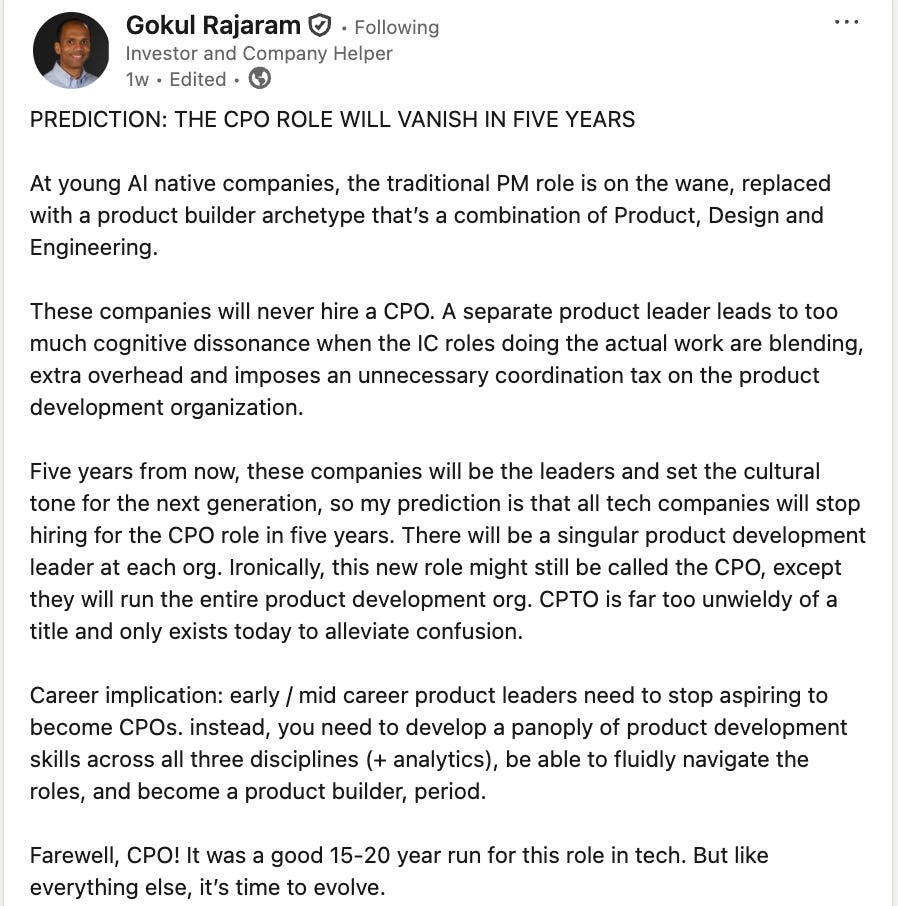
The Shift: As Gokul Rajaram recently noted, the “Traditional PM” is dying. The industry is shifting toward individuals who build the end-to-end product. LinkedIn has already leaned into this, rebranding its APM program to Associate Product Builder (APB).
The Outcome: The new leader is a creator of work, not just a manager of it.
But it’s not a silver bullet. Context matters.
While the rise of the Builder is undeniable, it is not a universal replacement for every role at every company.
Where it’s a clear win: If you are an AI-Native startup (like Perplexity or Midjourney) or a Challenger Brand, barriers to entry are zero and competition is infinite. You don’t have a brand moat yet. Your only survival mechanism is being first. You need Builders who can ship features daily to stay relevant.
Where you should pause and think: If you are Airbnb, Affirm, or NerdWallet, trust and compliance is paramount to your stability as a company. If a builder “moves fast and breaks things” in a checkout flow or a loan application, you lose millions or face regulatory fines. Here, the assembly line of QA, Legal, and Security is a feature, not a bug. You need deep specialists to protect the core.
That being said, we would argue that every company is now in a race for velocity.
Even in trust-heavy companies, the Builder role will emerge in specific zones. For example, a Growth Team at NerdWallet focused on spinning up landing pages (LPs) or top-of-funnel experiments is the perfect home for a Product Builder. They can generate dozens of LP tests with some direction on hypotheses to a few AI agents, all building new marketing assets without touching the regulated core banking infrastructure or involving additional members of the team.
The Rule of Thumb: Hire Builders to find value (0-1). Hire Specialists to protect value (1-N).
The Archetypes of the Product Builder
The limiting factor is no longer the ability to code; it is having the taste and intuition to find Product-Market Fit (PMF). We’ve identified three dominant archetypes. While they all ultimately drive revenue, their method of attack (their leading indicator) is different.
The GTM-Facing Builder
The Philosophy: “The fastest way to revenue is to stop building things nobody wants.”
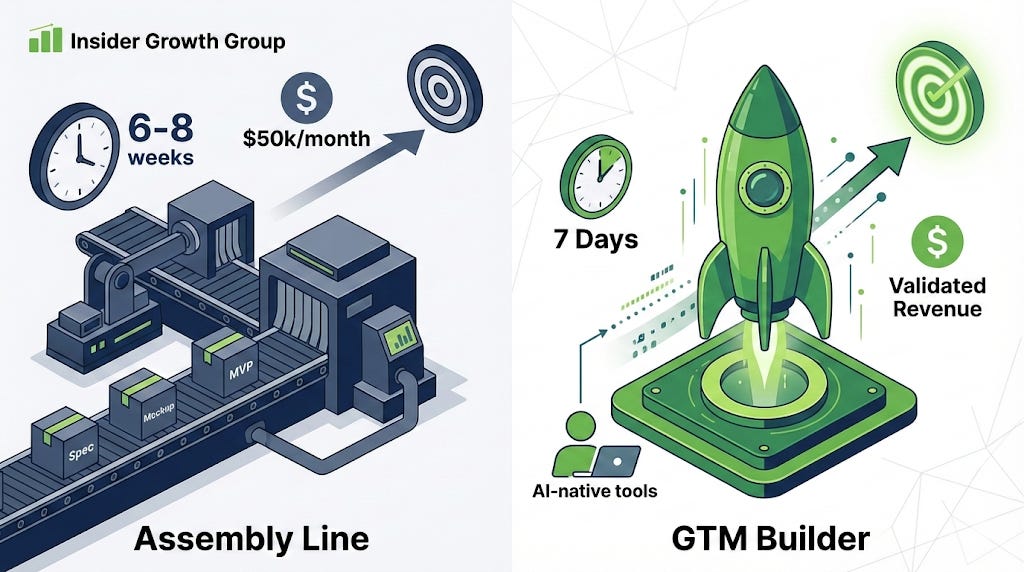
The Old Way (The Spec): You write a PRD for a calculator tool. You wait 3 weeks for design. You wait 2 sprints for engineering. Time to Live: 8 Weeks.
The New Way (The Build): You identify the need. You use an LLM to script the logic and v0 to build the UI. You deploy it to a sub-domain yourself. Time to Live: 48 Hours.
Primary Lever for Revenue: Validation Speed. They save the company millions by killing bad ideas in days, not months. This is not limited to small features, this builder will build what it takes to build a business case with real customers.
The Craft-Facing Builder
The Philosophy: “The fastest way to revenue is to build trust through quality.”
The Old Way (The Handoff): Design creates a beautiful interaction in Figma. Engineering simplifies it to save time. The final product feels “clunky.” Users churn because it feels cheap. This is the “Handoff Tax.”
The New Way (The Build): The designer uses Figma-to-Code, Cursor, or Claude to write the actual Tailwind CSS. They submit a Pull Request, not a picture. The vision is preserved 100%.
Primary Lever for Revenue: Perceived Value. They drive conversion and retention by ensuring the product feels premium and trustworthy.
Founder “The Ultimate” Mode Builder
The Philosophy: “The fastest way to revenue is to take more shots on goal.”
The Old Way (The Committee): To build a feature, you need a PM (Strategy), an EM (Feasibility), and a Designer (UX). They spend 40% of their time in “alignment meetings.”
The New Way (The Build): One person owns the stack. This doesn’t have to even be a past engineer. In fact, most times it’s not. They use AI to handle the “grunt work” of database migrations, allowing them to focus purely on which features to build, how the system should function, and user psychology. Zero communication overhead.
Primary Lever for Revenue: Iteration Velocity. They out-learn the competition by shipping 10x faster.
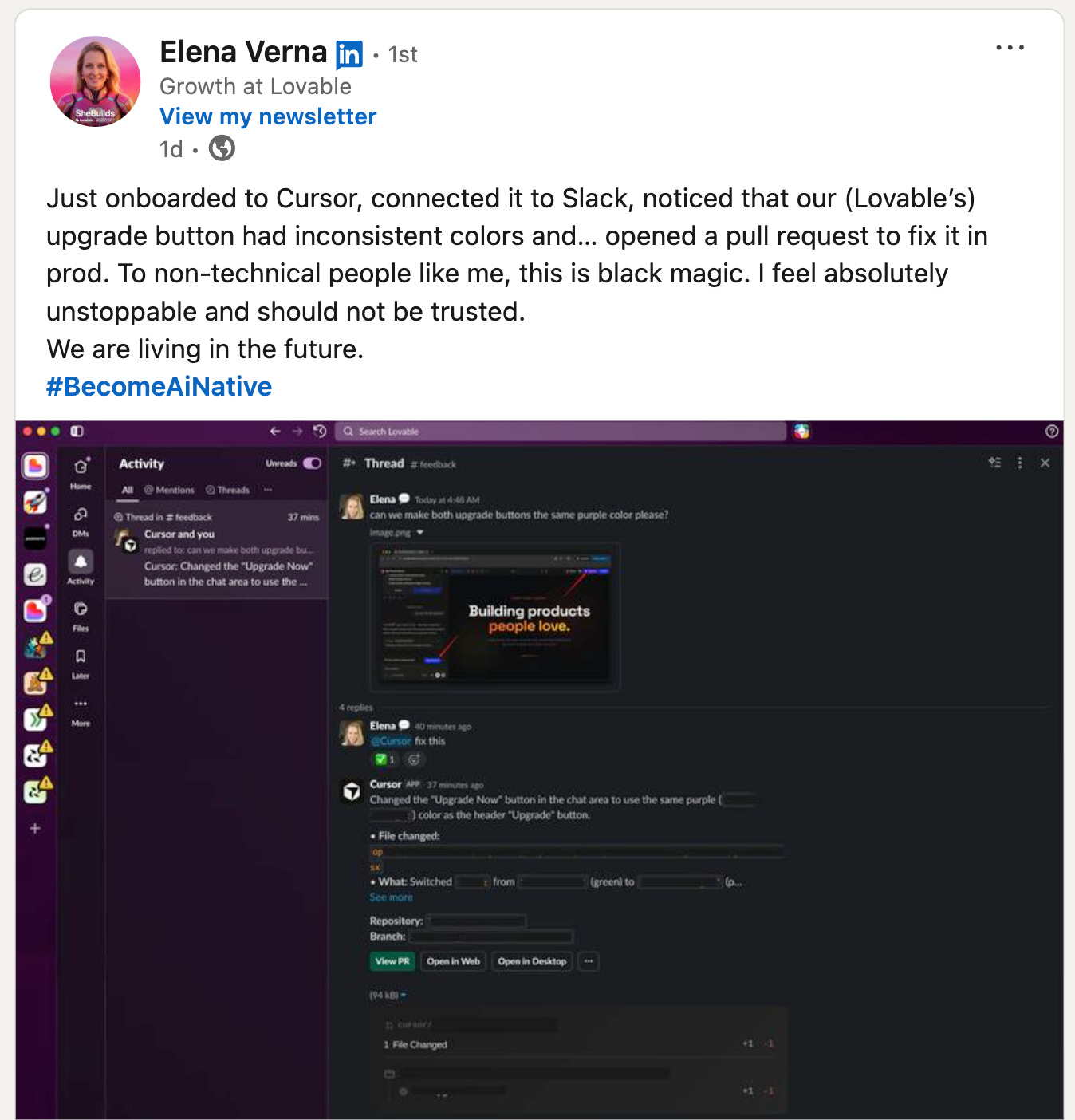
When something like the below is possible, you know the base expectations have changed.
Case Study 1: The GTM Builder
The Problem:
During Gaurav’s time at HomeLight, the team identified a potentially massive market segment. However, in the standard quarterly planning cycle, the idea was deemed too risky. Without proven demand, the core product and engineering leadership could not justify allocating a full pod to build it.
Under the traditional assembly line model, testing this would have required a dedicated PM, a designer, and two engineers—a burn rate of $50k/month for a feature that might flop. The initiative was stuck in prioritization purgatory: valuable enough to discuss, but too unproven to build.
The Solution:
Instead of fighting for roadmap space, Gaurav deployed a single GTM Builder to bypass the queue entirely. The mandate was clear: “Don’t ask for engineers. Prove that this is WORTH building in a week.”
The Builder executed to earn the right to invest further:
The “Scrappy” Backend: They didn’t wait for the platform team to provision a scalable environment. They spun up a basic backend themselves to handle the core logic and data flow. It wasn’t “enterprise-ready,” but it was functional.
The Transaction (Stripe): Because modern tools make payments trivial, the Builder integrated Stripe directly. They didn’t need a “Billing Team” or a lengthy approval process; they just needed an API key to start capturing real credit cards immediately.
The Outreach: They launched a direct outbound campaign pitching the value proposition, driving traffic to a working prototype that could actually service the user.
The Impact:
In 3 weeks, the initiative had generated real revenue and a committed waitlist.
This data changed the conversation. The initiative went from a risky bet to a proven winner. When they eventually brought in the core engineering team, the spec wasn’t based on guesses—it was based on automating a workflow that was already generating cash. The Builder hadn’t just built a prototype; they had built the business case that unlocked the resources.
The Lesson:
In the 0-1 phase, you aren’t buying software; you are buying truth. The “GTM Builder” proves the check before the tech. Specialists are expensive waiting rooms for information; Builders are cheap iteration loops that get you to the truth faster.
If you’ve gotten this far, you may be ready to navigate to the 🔥 section and check out our Playbook now.
Case Study 2: The Craft Builder
The Problem:
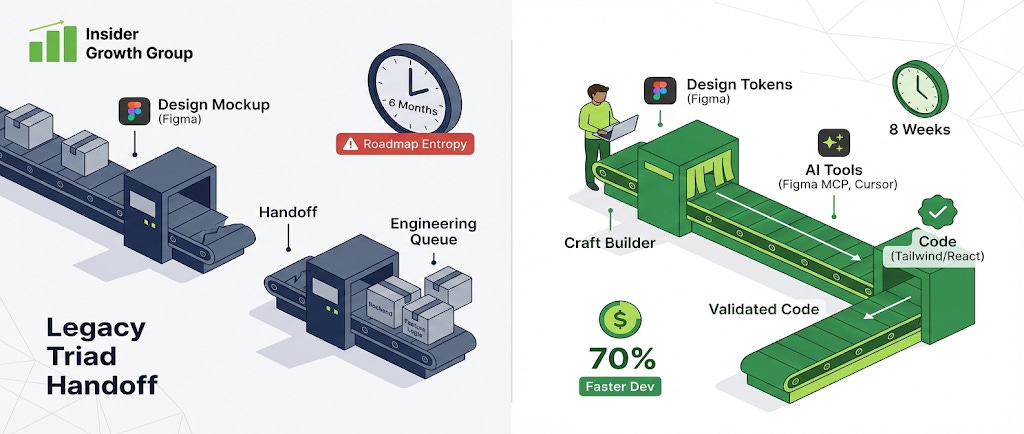
As HomeLight expanded to serve a complex ecosystem of agents, buyers, sellers, and lenders, the engineering landscape fractured. The team was spinning up new applications and repositories to handle these distinct personas. It became critical to have a unified design system that could be easily distributed across every application to maintain brand trust.
In the legacy model, this was a logistical nightmare. Designers would create beautiful component libraries in Figma, but implementing them across three or four different repos was the antithesis of speed. For a backend-focused engineering team, manually porting pixel-perfect buttons to multiple codebases wasn’t just low priority—it was a misuse of high-leverage resources. This created roadmap entropy, where the design system lived perfectly in Figma but was fragmented and broken in production.
The Solution:
Instead of hiring a specialized “Design Systems Engineer,” Gaurav empowered an existing Product Designer to evolve into a Craft Builder. They weren’t a coder by trade, and they weren’t a new hire. They simply adopted the new toolset available to them.
This Builder was given access to the codebase and the autonomy to ship frontend changes directly. Instead of creating a “picture” of a component and hoping an engineer would build it correctly four times, they used Figma MCP to translate design tokens directly into Tailwind configurations. They used Cursor to prototype the actual React components and push them to the production repo.
The “Technical” Myth:
A common objection is: “Most designers aren’t technical enough for this.” But this designer didn’t need to learn complex computer science. The bar for what is considered “technical” has changed. Connecting Figma to an IDE via AI agents isn’t “engineering”—it’s modern design. While it required some initial collaboration with engineering to set up the environment, that partnership made the designer more confident, not less.
The Impact:
The “handoff” was eliminated because the design was the code. Frontend development time dropped by 70%. The distributed design system, originally slated to take six months of engineering coordination, was deployed across multiple apps in eight weeks.
The Lesson:
Designers and PMs have tricked themselves into believing that touching code is “too technical.” AI tools allow your team to bypass the translation layer entirely. If your designer can’t tweak a component and your PM can’t prompt a functional UI change, you are stuck in the old way . In the AI era, the handoff is a bug, not a feature.
Case Study 3: The Builder Reboot
The Problem:
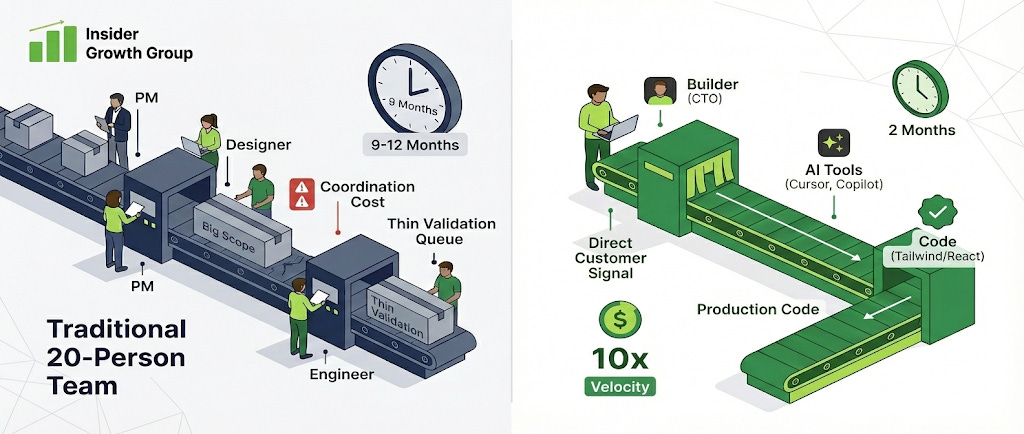
An early-stage startup with a 20-person engineering team kept shipping large bets that missed the mark. The scope was bloated, customer validation was thin, and direction kept changing after launch. At their current pace, the next major product was projected to take 9-12 months to deliver.
The Validation Trap:
A common question here is: “Why didn’t they just use the Litmus Framework to validate this before building?”
The answer lies in scale vs. speed. The Litmus Framework is powerful for organizations (typically >100 people) where you need to coordinate distinct GTM and Product teams to ensure alignment. But in a 0-1 environment, coordination is the bottleneck. Even a “lean” process requires a meeting. When you are trying to find a vein of gold, you don’t need a meeting between the geologist and the miner; you need a geologist who can dig.
The Solution:
The CTO stepped back into an IC role to become the Ultimate Builder. He bypassed the entire organizational layer—no spec handoffs, no coordination meetings, no sprint planning.
He used AI tools to write production code for the first time in four years, working against a fresh codebase while talking directly to customers every day. The feedback loop wasn’t: Customer → Sales → PM → Ticket → Engineer. The feedback loop was: Customer → CTO → Code.
The Impact:
A single builder with high agency and AI tools delivered in two months what a 20-person team would have taken nearly a year to ship. The beta generated immediate customer pull because the person building it was the same person hearing the customer pain.
The Lesson:
Traditional validation frameworks (like Litmus) manage the handoff of signal between teams. The Builder collapses the stack entirely. In 0-1, the bottleneck isn’t engineering capacity—it is coordination cost. Every layer between the customer and the keyboard dilutes the signal. The Builder removes the noise.
Justin’s Proof Points: Real-World Manifestations
Justin sees these archetypes appearing across the most successful teams in his network, and they serve as proof that this isn’t just a theory—it’s the new standard for elite teams.
The Evolved Founder [Ultimate Builder]
Justin worked with a former PM who co-founded a company right before the ChatGPT-3 boom. This individual didn’t hire a massive engineering team. Instead, he leaned into the AI tools. Today, he spends 80% of his time coding. He submits nearly as much code as his CTO co-founder while maintaining full product ownership. He isn’t a “PM who codes”—he is a Builder.The Customer-Centric CTO [GTM Builder]
Justin advises a startup CTO who has changed his hiring profile. He no longer hires “product engineers” who wait for a spec. He hires “PM Builders.” These individuals work directly with customers, identify the friction, and build the feature. If the feature gains traction and needs to scale to their entire user base, it is then handed over to a specialized Platform Engineering team to be rebuilt for scale. This ensures they never waste time “over-engineering” a feature that nobody wants.The “Design Engineer” [Craft Builder]
In Justin’s network, the most sought-after designers are those who write all the code necessary for both polishing features and making UX improvements. They don’t leave it to an engineer to “best effort” the animations or the transitions. They ensure the high-fidelity vision actually makes it into production. They are the guardians of the user experience, and they use code as their tool.
The Trap: When “Cheaper” Means “Worse”
This may be the most critical section of this entire article.
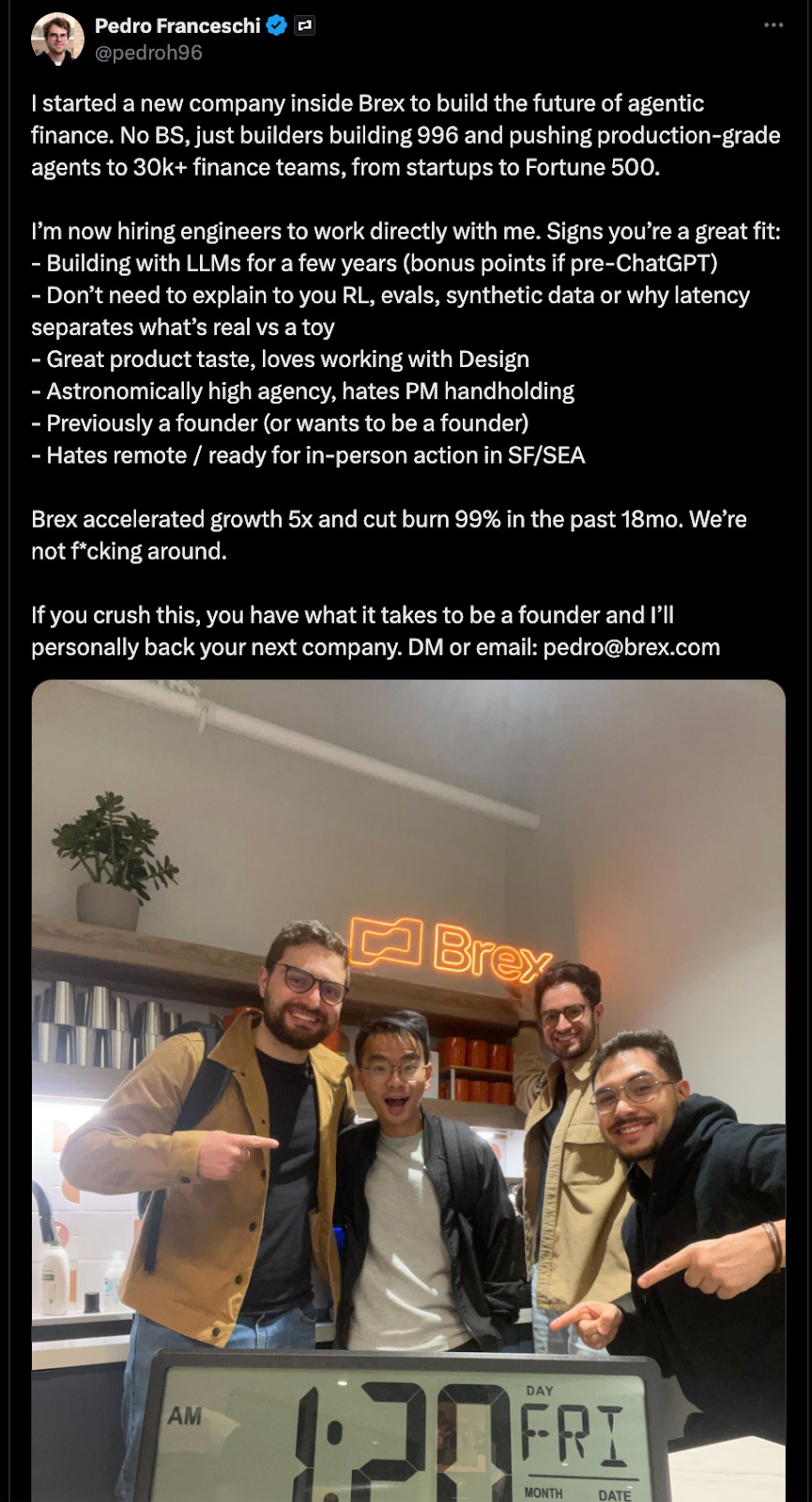
We are seeing a dangerous trend in teams that rush to convert PMs into Builders: The “Feature Factory” on steroids.
Because shipping is cheap, teams stop asking “Should we build this?” and start saying “It only takes 2 days, let’s just ship it.” The result? You get 10x the features, 10x the code bloat, and 10x the customer confusion—but zero increase in hits on goal.
The common concern brought up about the “Builder PM” is that they stop thinking and start tinkering. When the cost of construction drops to zero, the cost of Strategy and Taste skyrockets.
We argue that when this happens, the builder is not fitting into the role expectations of a builder, and instead starts trending towards being a traditional “growth hacker”. This is not the purpose of the role, but we acknowledge that there needs to be some framework to prevent and monitor this.
The New Gatekeeping: Protecting the Signal
In the old world, engineering capacity was the gatekeeper. You couldn’t build bad ideas because you didn’t have the engineers to spare. In the new world, that constraint is gone. You must manufacture artificial friction to replace it.
Here are the three gates we recommend to ensure Builders don’t just generate noise:
Gate 1: The “Write-Before-Code” Rule (Strategic Friction)
Just because you can build it in 48 hours doesn’t mean you skip the strategy.
The Rule: No line of code is written (or prompted) until a 1-Page “Bet” is approved.
The Content: It must define the Customer Pain, the Hypothesis, and the “Kill Criteria” (e.g., “If <10% of users click this in 3 days, we delete it”).
The Why: This forces the Builder to solve the problem in their head before they solve it in the IDE. It prevents “tinkering.”
Gate 2: The “Silent Beta” (Brand Friction)
Builders can ship to production, but they cannot ship to everyone.
The Rule: All Builder experiments launch to a <5% Segment or a “Lab” environment first.
The Why: This protects your brand and your “core” users from the chaos. If the feature is a “miss” (which 80% will be), it dies silently without confusing your entire user base.
Gate 3: The “Trash” Default (Technical Friction)
This is the hardest cultural shift.
The Rule: Every feature a Builder ships is Temporary by Default.
The Mechanism: If a feature does not hit its success metrics within [X] weeks, it is automatically reverted. It does not “earn” the right to be refactored by Core Engineering until it proves revenue/retention.
The Why: This prevents your codebase from becoming a graveyard of failed experiments.
The Takeaway: Velocity is a vector: it has Speed and Direction. The Builder gives you Speed. The Gate gives you Direction. Without the Gate, you can’t enforce moving fast with intention.
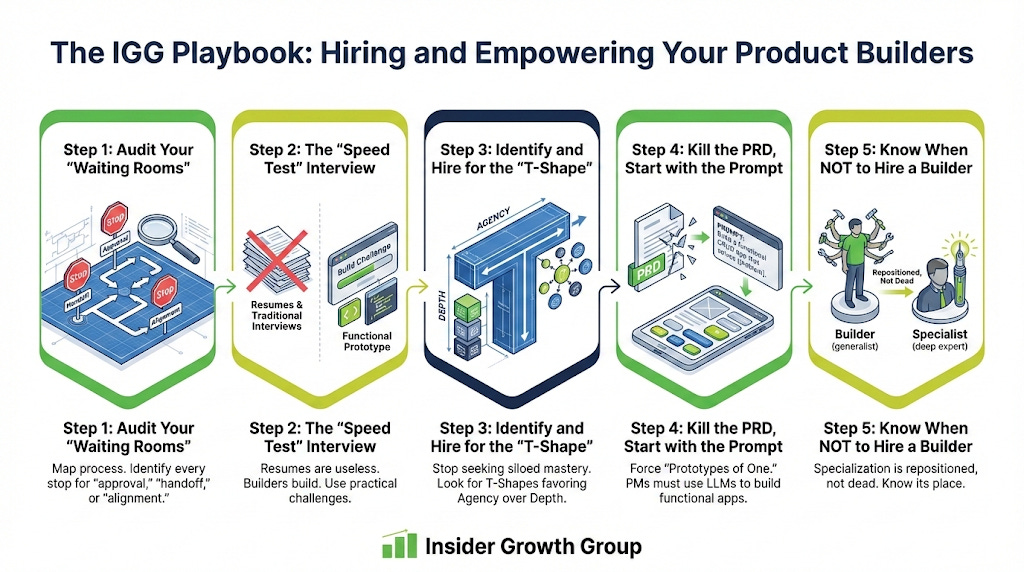
🔥 Insider Growth Group Playbook: Hiring and Empowering Your Product Builders
Transforming your organization into an AI-native, builder-first culture is not a matter of changing titles—it’s a matter of changing incentives and operations.
Step 1: Audit Your “Waiting Rooms”
Map out your current development process. Identify every point where a project stops for “approval,” “handoff,” or “alignment.”
The Litmus Test: If a PM has to wait for an engineer to change a headline, a copy line, or a button color, you have a specialization problem. You are paying a “Process Tax” that is killing your velocity.
Step 2: The “Speed Test” Interview
Resumes and traditional interviews are useless for identifying Builders. Builders build.
The Prompt: Give the candidate a real business problem and 48 hours.
The Goal: Build a functional tool or feature using AI.
The Evaluation: * Do they have “Taste”? Does the solution actually solve the user problem?
Can they navigate the “Last Mile”? Anyone can generate a “toy” with AI. Can they handle the latency, the error states, and the deployment?
Agency: Did they ask for permission/clarification on every detail, or did they make strategic assumptions and keep moving?
Step 3: Identify and Hire for the “T-Shape”
Stop looking for 10/10 mastery in a single silo. Look for the “T-Shape” that favors Agency over Depth.
9/10: Agency / “Getting sh*t done.” The ability to find a way around a blocker without asking for help.
8/10: Product Strategy. Understanding why we are building.
7/10: Visual Design & UX Taste. The ability to create a high-utility interface.
5/10: Technical Literacy. Using AI to write, debug, and push code. (Remember: AI bridges the other 5 points of code).
Step 4: Kill the PRD, Start with the Bet
The era of the 30-page requirement document is over. A document is a hypothesis; a build is a test.
The New Standard: Force your PMs and Designers to move from writing about the product to building the product. The Spec is no longer a doc; it is a functional URL or a Repo that an engineer can actually use.
The Constraint (Gatekeeping): Do not confuse building with tinkering. Before a Builder touches a prompt, they must write a 1-Page Bet defining the customer pain and the “Kill Criteria.”
The Bar: If a PM can’t use an LLM to spin up a solution to validate a problem, they aren’t a Product Builder—they are a project administrator. The goal isn’t to replace engineers; it’s to stop wasting their time on unproven ideas.
Step 5: Know Your Battlefield (Where Builders Win vs. Lose)
The Product Builder is a “Wartime” role. They thrive where velocity is the only moat. They struggle where stability is the product.
The “Velocity War” (Hire Builders):
If you are an AI-Native startup or a Challenger Brand, you are in a market where barriers to entry are zero. You don’t have a brand moat yet. Your only survival mechanism is being first. You need Builders who can ship experiments daily to find value (0-1).The “Moat Optimization” (Hire Specialists):
If you are Airbnb, Affirm, or a Bank, your moat is Trust and Compliance. A broken checkout flow costs millions; a slightly slower feature launch does not. Here, the “Assembly Line” (QA, Security, Legal) is a feature, not a bug. You need Specialists to protect value (1-N).
The Rule of Thumb: Hire Builders to find the truth (Innovation). Hire Specialists to scale the truth (Optimization).
Conclusion: Starting vs. Scaling
The core takeaway is simple: Specialization is for scaling. Generalization is for starting.
If you are in a 0-1 phase, whether that’s a new startup or a new department inside a public company, don’t hire a large team.
Hire a Product Builder. They are the high-leverage operators who turn AI into revenue by doing the work of three specialists in half the time. They are the ones who will navigate the uncertainty of the AI era and find the path to revenue while your competitors are still “aligning” on the spec.
Don’t Start from Scratch. We have already built the infrastructure for this transition. Stop guessing at the job description and stop using generic interview questions.
Access our gated Product Builder Hiring Kit to get:
The GTM Builder JD: The exact “Forward Deployed Founder” template we use.
The Craft Builder JD: The “Product Designer (Builder Track)” role definition.
The “Speed Test”: The 48-hour take-home prompt that reveals agency instantly.
I worked at HomeLight during all these changes and I can testify Gaurav applied this playbook and help us grow.
Thanks for sharing this in an organized and clear way, with tons of practical examples.
I find this article exciting, frustrating, and a bit overly optimistic. Are any of you willing to engage in a discussion regarding use cases not represented and/or the notion that tools produce “production” code?